
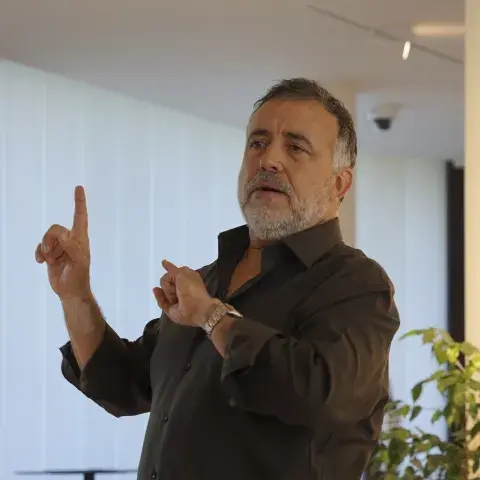
At Franklin’s latest Meet the Manager event, the Next in Management team welcomed Dr. Waldo Perez, a geologist whose career has taken him from academia to mining over more than three decades. He has served as President and CEO of Neo Lithium, Lithium Americas, and Latin American Minerals, and led exploration in Argentina, Canada, Paraguay, and Colombia. His work has taken him to well over 100 mineral prospects across the Americas and helped uncover some of the world’s largest lithium deposits. Many would say he struck gold, but few know how deep he had to dig to get there.
Perez opened by reminding students that mining is often thought of as part of the “old economy,” even though it laid the foundation for almost every empire in history. He then discussed its continuing relevance in modern society and his own role in the industry. According to Dr. Perez, mining changed dramatically in the 2000s, when the emergence of internet companies meant that large mining firms suddenly had to compete for investors’ risk capital. Investors increasingly judged these firms by their bottom line, making exploration seem like a cost rather than an investment. Much of that work was therefore passed to smaller junior mining companies. Dr. Perez saw an opportunity in this shift: discover a valuable mineral resource and sell it to the highest bidder.
He believes that discovery is the purest form of value creation, defining discovery as “the process of finding or learning something for the first time that was previously unknown or unrecognized.” Still, he warns that discovery is a slippery slope in mining: is the discoverer the person who first spots the mineral deposit, the one who finances the mine, the one who owns the rights, or the one who proves it can be profitable? Perez’s track record demonstrates how difficult discovery truly is.
The first two, La Paloma and El Tranquilo, were discovered in Argentina in the early 2000s with financing from Barrick Gold, which later sold both projects to Patagonia Gold. The third, Paso Yobai in Paraguay, opened in 2012, but the company went bankrupt when gold prices fell from $1,800 to $1,100 an ounce. Local miners took over the site, which remains profitable today. His fourth project, Cauchari, began as a potash prospect before the team found lithium there. It became the world’s second-largest lithium resource, but board conflicts, poor timing, and political challenges led to its sale to China’s Ganfeng Lithium for $260 million. Once again, Perez saw no personal financial benefit.
His fifth discovery, Tres Quebradas, finally paid off. As lithium demand rose in 2015, Perez put the lessons from his earlier projects to work. He built a tight board, secured a royalty on production, and reunited the Cauchari team. Neo Lithium was eventually sold to Zijin Mining for roughly $1 billion. As he put it, it took five mines for him to make a dollar.
Drawing on this journey, Dr. Perez shared seven lessons for creating value. Foremost was persistence: “One hundred times may not be enough.” He urged students to respect investors’ money while putting their own skin in the game, and to never stop learning. On leadership, Perez placed greater value on attitude and effort than on knowledge and urged students to hold on to good people and stay close to the work their teams do on the ground. He also stressed the importance of choosing the right legal and business environment, being wary of a difficult board, and staying ahead of the pack.
Dr. Perez closed with a twist on a familiar phrase: carpe diem, cras carpere, meaning seize the day, but seize tomorrow too. Think about where the future is heading, he told students, or someone else will define it for you. For Dr. Perez, luck is a matter of statistics: the more often you try, the more chances you have to succeed. That brought him back to his first lesson, persistence. “Success is a statistical anomaly,” he said, “so enjoy the ride.”