
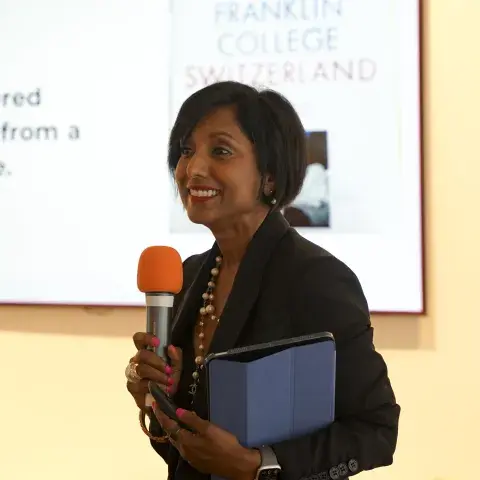
When Sumindi Peiris arrived in Lugano in 1991, she had no idea that the next three decades would take her across some of the world's most recognizable brands, and eventually to become the co-founder of The Host Stand Agency and founder and CEO of Moxi Branding. At Franklin's latest "Meet the Manager" event, the Class of 1994 alumna made one thing clear: none of it happened alone.
Born in Sri Lanka and raised in the US, Peiris arrived on campus the way most students do, a little unsure, a little far from home. What changed things, she said, was realizing that success doesn't come easy. Her father became her first mentor. Later, a marketing professor became her champion, someone who saw something in her before she saw it herself and guided her toward the career that would define her life. That push came with a hard moment, too: telling her father she was changing her career path was one of the harder conversations she had. But as she put it: "at the end of the day, the decision is yours."
Her first Academic Travel took her to Berlin in 1991, and looking back, what mattered most wasn't the trip itself but the friendships she formed outside the classroom. That idea came up again and again in her talk: some of the most valuable parts of her Franklin experience happened outside of the classrooms. She also mentioned something she hadn't given much thought to at the time: she learned Italian while at Franklin, and two decades later, that decision proved useful in a boardroom in Rome, where being able to speak the language changed the course of the meeting. Her takeaway was simple: go with your gut, even when others question the choice. You often can't see the payoff until much later.
Sumindi also didn’t hold back from campus life. She served as a Resident Assistant and Student Government Treasurer before going on to become Student Government President. She took on these roles not because they’d look good on a resume, but because, in her words, she “embraced everything this place offered."
Her career later took her through some of the biggest names in the industry, and one idea that she really emphasized was that: people don't fall for products, they fall for how those products make them feel. Hennessy is a good example, as Sumindi moved the brand away from being seen as "just a drink after dinner" towards something rooted in community and celebration. At Waldorf Astoria, the goal was making luxury feel the same everywhere, so a guest checking in New York had the same emotional experience as one checking in Chengdu. And with Johnnie Walker Blue Label, the insight was deep as well: people weren't just buying a bottle, they wanted the sense that someone had been with them the whole way, which is exactly what made it such a meaningful gift. She shared a challenge in her career that no one could have prepared for: COVID-19. She and the Time Out team rebuilt websites and magazine covers within 24 hours to help people find ways to connect with each other online and, she noted, in a strange way people became closer during a time defined by distance.
As it might happen to any of us, not every decision of hers was driven by passion. She once chose one role over another because it seemed like the more "feminine" fit, and quickly learned that job just didn't feel right. Her advice was this: sometimes you have to try the wrong-feeling thing to recognize the right one.
Looking back, Peiris said the mistakes shaped her more than her successes, whether that meant learning to speak up after a launch she didn't believe in failed, or discovering that some of her most meaningful work came from stepping outside what was expected of her. That same willingness to trust her own instincts, she said, is what set her apart early in her career: in a room full of people with better GPAs and more polished resumes, what carried her wasn't credentials, it was an instinct for how people make decisions and what motivates them, something she learned during her time at Franklin.
Peiris had a reassuring answer for anyone worried about how a liberal arts degree looks to recruiters: stop trying to compete on the same terms as everyone else. You may not have the most specialized resume in the room, but you've got something a lot of other candidates don't, an instinct on people, the ability to adapt to different situations, to connect dots that don't obviously belong together. Lean into that, she said, don't hide it. And that same instinct should shape how you present yourself on paper, too. Write something that actually sounds like a person, then back it up with results, not job duties. As for AI, she was clear: use it to sharpen what you already know, not to invent what you don't. Build your reputation through the people who've actually worked with you, not through self-promotion. And keep learning, always.
By the end of the talk, Peiris summed herself up in three words: "I am a connector." Looking back, every job she's held shared the same underlying goal as her personal life: to inspire connections between people. She left students with a question worth sitting with, regardless of what career path they choose: What is the mark you want to leave, no matter what your goal in life is?