FIND THE PROGRAM THAT'S RIGHT FOR YOU
At Franklin Switzerland, every undergraduate degree is built around flexibility, academic exploration, and personalized learning.
Rather than following a fixed curriculum, you will build your bachelor's degree step by step, choosing a major, exploring other disciplines through electives and minors, and working closely with faculty advisors to create an academic path that reflects your interests and goals.
Whether you already know what you want to study or are still exploring your options, Franklin's liberal arts curriculum gives you the freedom to design a degree that's uniquely yours.
UNDERSTANDING THE LIBERAL ARTS MODEL
Despite its name, a liberal arts education isn't limited to the arts. The term comes from the Latin artes liberales ("the arts of a free person") and refers to an educational tradition that prepares students to think critically, communicate effectively, and solve complex problems.
Learn more about we apply the liberal arts educational model here at Franklin Switzerland.
What is a liberal arts education?
A liberal arts education combines in-depth study in one field with exploration across different disciplines. Students develop expertise through their major while gaining broader knowledge, critical thinking skills, and the ability to connect ideas across subjects. At Franklin Switzerland, this approach allows students to create a personalized degree that reflects their interests and future goals.
Is a liberal arts education only about arts and humanities?
No. Liberal arts includes a wide range of disciplines, including business, economics, environmental studies, communication, social sciences, sciences, and the arts. The goal is not to study only one type of subject, but to develop the ability to understand complex topics from different perspectives.
Is a liberal arts degree useful for my career?
Yes. A liberal arts education develops skills that are highly valued by employers, including analytical thinking, communication, collaboration, creativity, and the ability to adapt to new challenges. Because students learn how to approach problems from different perspectives, liberal arts graduates pursue careers across many industries, including business, sustainability, communication, international relations, consulting, education, and entrepreneurship.
What is the difference between a liberal arts education and a traditional degree?
Traditional degree programs often require students to specialize in one field from the beginning. A liberal arts education combines specialization with exploration. At Franklin Switzerland, students develop expertise through their major while also taking courses across disciplines, allowing them to build connections between different areas of knowledge and personalize their academic journey.
Does a liberal arts education prepare students for graduate school?
Yes. The broad academic foundation and strong emphasis on research, writing, analysis, and independent thinking prepare students for many graduate programs, including law, business, sustainability, international relations, education, and other fields.
How your bachelor's degree works
Franklin's undergraduate programs are completed over four years and lead to either a Bachelor of Arts (BA) or a Bachelor of Science (BS), depending on your chosen field of study.
Throughout your degree, you will combine:
- Core Requirements courses that provide a broad academic foundation
- A Major, your primary field of study
- Elective courses that allow you to explore different disciplines
- Optional Minor or interdisciplinary pathways
- Experiential learning opportunities, including Academic Travel, research, internships, and community engagement
Working closely with your academic advisor, you will build a degree that balances structure with flexibility while supporting your academic and career goals.
Looking to Graduate in Three Years?
Students who already have a clear academic direction, have already completed the minimum requirement, or are ready for a more intensive course load may be eligible to complete their bachelor's degree in three years instead of four.
Franklin's 3-Year Degree option allows motivated and eligible students to accelerate their studies while benefiting from the same liberal arts education, personalized advising, and international learning experiences.
EXPLORE
Before You Decide
Unlike many university systems where students specialize immediately, Franklin allows you to explore different subjects before officially declaring your major.
During your first semesters, you will take courses across a variety of disciplines while fulfilling general education requirements. This gives you time to discover new interests, better understand your academic strengths, and make an informed decision about your field of study.
Most students officially declare their major during their sophomore year.
Franklin Switzerland offers undergraduate majors across business, economics, communication, environmental studies, international relations, psychology, history, literature, the arts, and more.
Core Requirements
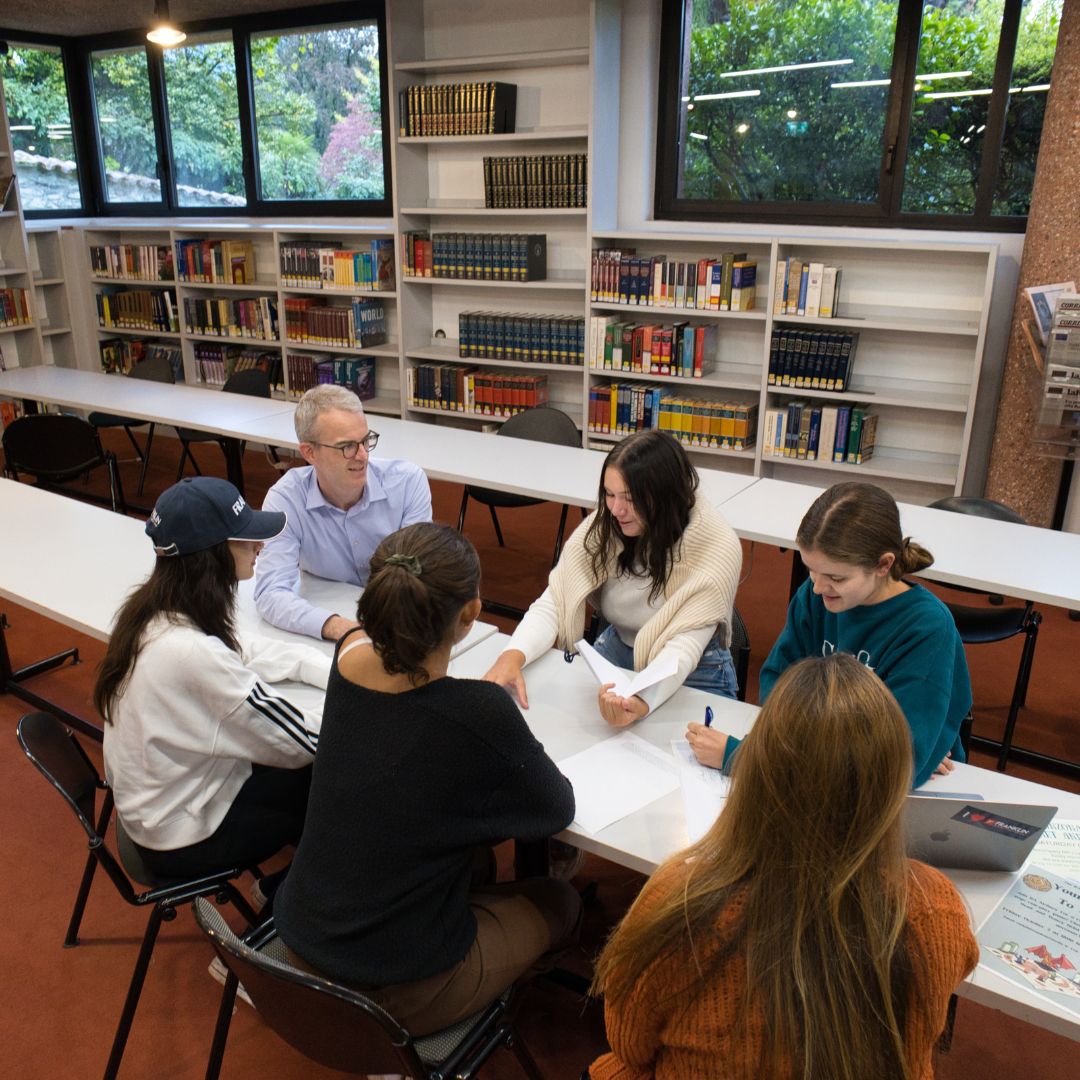
Franklin's Core Requirements merge academic skills with a strong focus on international and intercultural competencies. These courses give you the tools you need to study, research, communicate, and live responsibly, while crossing borders and traveling far from home. The university core represents the heart of the Franklin experience.
New first-year students and transfer students with fewer than 30 credits are assigned a First-Year Seminar (FYS), a three-credit, semester-long course that reflects a specific research interest of the Franklin faculty members who lead them. The broad aim of FYS is to help students adapt to academic expectations and the university experience, engaging them both in and out of the classroom. This seminar is an integral part of a larger First Year Experience that integrates academics with orientation, advising, academic support, co-curricular activities, and community activities.
Academic Travel is Franklin’s signature program and an essential part of the Franklin degree program. Three-credit Academic Travel courses are regular semester courses that include a 10-14 day travel period, thus adding an experiential learning piece to regular classroom activities. The graduation requirement for Academic Travel is normally fulfilled by successful participation in four three-credit Academic Travel classes (12 credits).
Being a student at Franklin means learning to write well in English, as well as being able to use that skill in other languages. After the first-year seminar, students enroll in an academic writing course (WTG 150 Academic Writing: Crossing Borders and/or WTG 200 Advanced Academic Writing: Ethics at Work) as part of the year-long experience and then later enroll in W-designated courses that are writing intensive. The writing requirement culminates with the capstone course, thesis, or senior project.
Students choose two courses from each Area of Knowledge (Intercultural Competencies - International Engagement - Social Responsibility) for a total of 18 credits, and they will be advised to complete courses from at least five different disciplines. Courses taken to meet major requirements may also fulfill core requirements; however, credits count only once in terms of meeting the 120 credit requirement for the bachelor's degree. These learning outcomes articulate what students are expected to demonstrate in terms of knowledge, skills, and attitudes upon completion of the Global Responsibility components.
As part of Franklin’s mission to cultivate international leadership skills through foreign language acquisition and cultural literacy, Franklin encourages all students to learn at least one Swiss language. Two options, or tracks, are available to students to ensure successful completion of this requirement. Students in Track 1 strive to achieve advanced proficiency in French, German, or Italian. Track 2 students opt for a combination of language study and cultural literacy classes across several Franklin disciplines. For all students, a two-semester commitment to Swiss language study (most typically satisfied in the 100-101 sequence) is mandatory.
Quantitative Literacy represents the ability to understand and effectively communicate in the language of numerical data, patterns, and structures. To distinguish between solid facts and fake news, fluency in this language is required. One needs to understand its rules, its uses, and the logic behind it, as well as possess the ability to recognize inappropriate or flawed uses. The Quantitative Literacy requirement provides students with the tools necessary to achieve this objective, in a way that is compatible with their field of interest.
Understanding Majors and Minors
Every undergraduate student completes a major, the primary area of study that forms the foundation of the bachelor's degree.
Many students also choose to add a minor, a secondary field that complements their major or allows them to pursue another academic interest.
For students whose interests naturally span multiple disciplines, Franklin also offers opportunities to pursue interdisciplinary pathways through Combined Majors or Double Majors.
These options allow every student to create an academic experience that reflects both their passions and their future goals.
Undergraduate program at a glance
Degree Length
4 years
(3-year option available for eligible students)
Degrees
Bachelor of Arts (BA) and Bachelor of Science (BS)
Majors available
18
Minors available
22
Academic Travel
Once a semester, included in the curriculum and fee
Degree Structure
Core Requirements + Major + Electives + Optional Minor
Academic Advisor
Personal faculty advising available for every student
YOUR UNDERGRADUATE JOURNEY AT FRANKLIN
Year 1
Explore
- Meet your faculty advisor
- Take First-Year Seminar and Foundational courses
- Take your first Academic Travel courses, one each semester
- Join a campus club and get involved
Year 2
Choose
- Declare your major
- Talk about professional pathways with your advisor
- Deepen your study with upper-level courses
- Help new students by becoming an Orientation Mentor
Year 3
Deepen
- Advance in your major (and consider a minor)
- Explore career possibilities and internships
- Finish remaining core requirements
- Explore more Academic Travel opportunities
Year 4
Achieve
- Start and complete your Capstone project or thesis
- Finalize your degree
- Prepare for graduate studies
- Apply for internships or jobs