
Franklin Switzerland and IE University have launched a new academic collaboration that brings students directly into the heart of a real-world environmental challenge. Through a joint project in Environmental Sciences, senior and junior students from both institutions are working on the development of a management plan for an invasive species in the Eresma River, near Segovia, Spain.
The initiative is structured as a competition between student teams from Franklin and IE University’s Environmental Science program. While the challenge is presented as a simulation, it is firmly grounded in reality: the case study is based on an ongoing project currently being carried out by Professor Patrick Della Croce in Ticino, Switzerland. The data collected and the methodologies applied are the same ones used to assess whether environmental interventions are effective in real ecosystems.
The primary objective of the project is educational. By engaging with a concrete environmental problem, students are exposed to the complexity of applied environmental science—where ecological theory, data collection, management strategies, and real constraints intersect. Rather than working on hypothetical scenarios, students are asked to think and act as environmental professionals, developing solutions that must be scientifically sound, feasible, and context aware.
The collaboration also highlights the growing partnership between Franklin Switzerland and IE University, formalized through a Memorandum of Understanding (MoU). This agreement enables academic exchanges and joint initiatives such as this one, reinforcing a shared commitment to experiential and internationally oriented education.
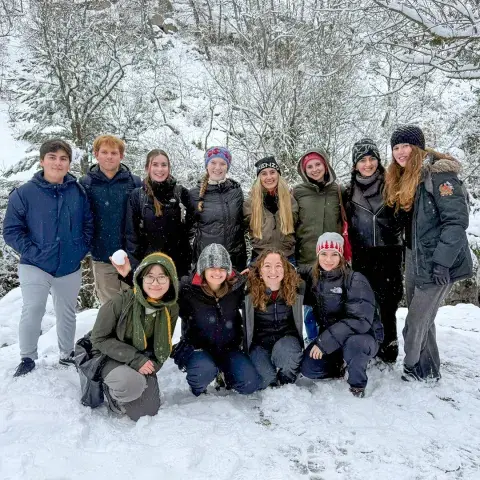
The project officially began in January, when selected Franklin students traveled to Spain to visit IE University in Madrid and Segovia. During the trip, students had the opportunity to visit the Eresma River site for which the management plan is being developed, observe the environmental context firsthand, and interact closely with IE faculty and students. This site visit played a key role in grounding the project in reality, allowing participants to better understand the ecological, geographical, and social dimensions of the challenge.
Throughout the semester, teams from both universities will continue working on their management plans, collecting and analyzing data, evaluating potential interventions, and refining their proposals. The competitive aspect of the project encourages collaboration, critical thinking, and innovation, while remaining aligned with academic rigor.
The project will culminate in April, when the best teams from IE University will travel to Franklin Switzerland for the final evaluation of the management plans. This concluding phase will not only determine the winning proposals but will also provide another opportunity for academic exchange, discussion, and reflection between students and faculty from both institutions.
By combining fieldwork, international collaboration, and problem-based learning, this initiative exemplifies Franklin’s approach to experiential education. It allows students to move beyond the classroom and engage with environmental issues as they exist in the real world—complex, interdisciplinary, and deeply relevant.